Pool Leak Detection in Brick, NJ
A leaking swimming pool is more than just a nuisance; it's a constant drain on your water bill, your pool chemicals, and potentially the structural integrity of the surrounding patio and landscaping. NJ Leak Detection offers expert pool leak detection in Brick NJ to locate leaks in inground pools, plumbing lines, and equipment.
Is It a Leak or Just Evaporation?
During the hot New Jersey summer, a certain amount of water loss is normal due to evaporation and splashing. However, losing more than a quarter-inch to half an inch of water per day typically indicates a problem.
The Bucket Test: Before calling a professional, you can perform a simple "bucket test." Place a heavy plastic bucket on the top step of your pool and fill it with water to match the pool's water level. Mark the water level on both the inside (bucket) and outside (pool). After 24 hours, if the pool water has dropped significantly more than the water inside the bucket, you likely have a leak. (Note: While useful as an initial check, the bucket test does not definitively prove a leak or tell you where it is.)
Signs of a Pool Leak
- Rapid Water Loss: Needing to add water more than once a week.
- Increased Chemical Demands: Constant addition of makeup water dilutes your chemicals, requiring more chlorine and balancing agents than usual.
- Air in the System: Bubbles returning to the pool from the return jets indicate an air leak in the suction side of your plumbing.
- Soggy Ground Around the Pool: Wet spots, sinking pavers, or unusual plant growth near the pool deck or equipment pad.
- Algae Growth: Difficulty maintaining water clarity despite proper chemical balancing can be a secondary symptom of constant water replacement.
Where Do Pool Leaks Occur?
Pools are complex systems. Leaks can occur in the shell, the fittings, or the underground plumbing. Common leak locations include:
The Skimmer: The connection where the plastic skimmer meets the concrete or fiberglass shell is a frequent source of leaks due to shifting or expansion and contraction.
Light Niches: The conduit that houses the pool light wiring is a common entry point for water if the seal fails.
Return and Suction Lines: The underground PVC pipes that carry water to and from the equipment pad can crack due to ground movement or freezing during harsh Brick winters if not properly winterized.
The Equipment Pad: Leaks at the pump, filter, or heater connections are usually visible but can sometimes be subtle drips that contribute to overall water loss.
Our Pool Leak Detection Process
Finding a pool leak requires a systematic approach:
- Visual Inspection and Dye Testing: We carefully inspect the skimmer, returns, main drain, and light niche. Using a specialized dye, we can observe if water is being pulled out of the pool at these common failure points.
- Pressure Testing the Plumbing: We plug the return and suction lines at the pool and pressure test the underground piping to determine if the leak is in the plumbing system.
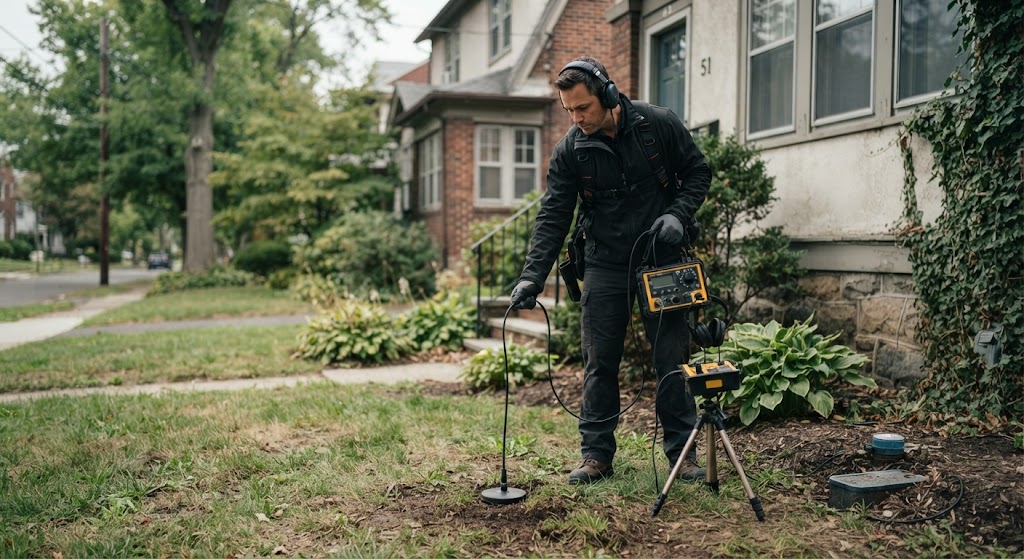
- Acoustic Listening: If a pressure test confirms an underground plumbing leak, we use sensitive listening equipment to pinpoint the sound of escaping water beneath the concrete deck or lawn.
By accurately locating the leak, we prevent the need to dig up large sections of your patio or yard to find the broken pipe.